
Your driving safety and vehicle performance depend a lot on picking the right wet weather tires that suit Singapore’s tropical climate. Many drivers struggle to choose between summer tires and all-season options during our frequent downpours. Summer tires give you great grip in wet and dry conditions, especially with temperatures above 35°C. All-season tires work well across temperatures from -10°C to +30°C.
The usual rules about tire selection don’t quite fit our unique climate here. Most advice suggests using all-season tires for temperatures below 7°C, but that rarely matters in Singapore’s weather. Summer tires could be a better choice for our hot, rain-soaked roads because they have shallow treads and stiff compounds. These tires excel at speed and agility, which makes them ideal for both city streets and expressways we use daily.
Let’s get into which option gives Singapore drivers the best wet weather performance. We’ll look at braking distances, cornering stability, and tire behavior in our mix of heat, humidity, and sudden downpours. You’ll learn whether summer specialists or versatile all-season performers are the best wet weather tires for your vehicle, regardless if you drive an SUV or sedan.
Singapore’s tropical climate and urban layout create unique challenges for drivers. You just need to understand these conditions to pick the right wet weather tires for your vehicle.
Rain falls heavily on this island nation throughout the year, with about . The monsoon seasons bring even more rain, especially from November to January. This constant exposure to water affects how tires perform.
Wet roads are a common sight, which makes tire grip crucial for safety. Heavy rain combined with smooth roads can reduce traction significantly. This makes wet weather tires a necessity rather than an option.
The high humidity makes rubber deteriorate faster. Moisture seeps into tiny cracks in the rubber compound, causing tires to age more quickly than in drier climates. Drivers should check their tires more often for signs of early aging like cracks in the sidewall or unusual wear patterns.
Singapore doesn’t have four seasons like other countries. Temperatures stay warm consistently between 23°C to 33°C all year. The usual 7°C threshold where all-season tires work better than summer tires doesn’t matter here.
The temperature rarely drops near this threshold. This makes traditional tire advice from temperate regions irrelevant for Singapore’s drivers. The constant heat brings different challenges – you just need to know how well tire compounds handle sustained high temperatures without getting too soft or wearing out too fast.
All-season tires might handle various temperatures well, but their cold-weather benefits don’t matter in Singapore’s year-round summer climate. The focus changes from cold weather performance to how well tires channel water away while gripping in tropical heat.
Singapore’s roads combine busy urban streets with fast expressways. This creates specific tire performance requirements.
City centers have lots of stop-start traffic. Tires must excel at short-distance braking and quick acceleration. The expressways like PIE, CTE, and ECP need tires that stay stable at high speeds, even during sudden downpours.
Singapore’s roads are well-maintained with few potholes. These smooth surfaces can actually increase the risk of aquaplaning when it rains heavily. Water tends to collect more evenly on smooth surfaces instead of draining through cracks.
The perfect wet weather tire should handle both reliable braking on slick surfaces and stay stable during quick lane changes on expressways. These urban driving patterns shape what makes an ideal tire choice for Singapore’s roads.
The basic engineering that sets summer and all-season tires apart plays a big role in how they handle Singapore’s wet roads. Drivers who know these key differences can pick their tires based on real performance rather than fancy marketing.
Summer and all-season tires use very different rubber compounds. Summer tires pack softer rubber that stays flexible in high temperatures and grips wet surfaces better. This flexibility lets the tire mold itself to tiny patterns on wet roads, which gives the best possible grip.
All-season tires work with rubber that handles a bigger range of temperatures . This jack-of-all-trades approach might sound good, but it’s not the best fit for Singapore’s hot weather. The rubber gets a bit harder in really hot weather, which means less road contact than summer tires.Summer tires’ special compounds are also better at handling heat. This matters a lot in Singapore’s year-round heat, especially with all the stop-and-go driving in city traffic.
Summer tires come with simpler tread patterns that put more rubber on the road – what tire folks call a higher “land-to-sea” ratio. This design creates bigger contact patches that grip both dry and wet roads better.
Good summer tires don’t need deep grooves to work well. They use special channels that move water away from under the tire quickly. This helps prevent hydroplaning during Singapore’s heavy monsoon rains.
All-season tires have more complex patterns with deeper grooves and extra sipes. They try to handle everything from rain to light snow, but this means they’re not the best choice for Singapore’s tropical weather.
Summer tires actually beat all-season tires in the rain. Their special treads push water away faster and resist hydroplaning, even when you’re driving fast.
Tests show that summer tires help you turn better and than all-seasons. This extra performance really counts when you’re dealing with Singapore’s sudden storms that can make roads slick in minutes.
All-season tires still grip wet roads well and work pretty good in different conditions. They last longer, which is nice since summer tires wear down faster in hot weather because of their softer rubber.
Singapore rarely sees temperatures cold enough to make all-season tires worth it. Summer tires are safer in wet weather, though you’ll need to replace them more often.
“At the heart of superior wet handling tires lies the advanced tread compounds. These compounds provide maximum grip, even in challenging tropical conditions.” — Tire Pte Ltd, Singapore tire retailer and expert resource
Real performance data shows how different tire types behave on Singapore’s rain-soaked roads. These numbers tell a clear story that goes beyond what marketing materials claim.
Quick stopping on wet roads can save lives. Tests prove that summer tires stop better than all-season ones in wet conditions. A car going 60 mph (~96 km/h ) with summer tires needs to stop on wet roads. The same car with all-season tires takes 215 feet (~65.53 meters) – that’s 58 feet (≈ 17.68 meters ) more. This difference equals gap of nearly 18 meters — about 4 car lengths and could determine whether you avoid a crash.
Not sure if your tires are still safe? Book a free tire check with us today. WhatsApp +65 6925 5296.
The numbers get worse with worn tires. Tires at the legal minimum tread of 1.6mm need an extra 6.8 meters to stop compared to new ones. Tire experts suggest replacement at 3mm tread depth because water displacement drops sharply below this point.
Your car’s grip in wet turns depends on tire quality. Summer tires shine here with up to grip on wet skid pads – better than many tires achieve on dry roads. All-season tires only manage 0.65g in similar conditions. This means less confidence while cornering.
Summer tires perform better because their special rubber stays flexible in Singapore’s temperature range. This helps them grip wet roads better.
Aquaplaning happens when tires can’t push away water fast enough. Water builds up between the tire and road. This often occurs at high speeds during heavy rain – a common scenario on Singapore expressways.
Fresh tires can push away 30 liters of water every second at 80 km/h. This ability decreases as tires wear down. The tread design makes a big difference. Special grooves and tread blocks work together to channel water away from where the tire meets the road.
Singapore drivers should focus on wet performance rather than all-weather capability. Our climate doesn’t need tires designed for temperature extremes.
The financial aspects of tire selection deserve careful assessment before you make your final decision. Let’s get into the economic factors that shape the wet weather tire debate in Singapore.
Tire types and sizes come with varying investment costs in Singapore’s market. Summer tires command higher prices because of their specialized design and performance advantages. Premium summer tires for standard sedans cost between , while comparable all-season options are priced lower. SUV owners looking for the best wet weather tires face steeper prices, with larger 19-21 inch tires ranging from SGD 268.42 to SGD 603.94 per tire.
Each tire’s installation adds about SGD 40.26, plus wheel alignment and balancing fees that can reach SGD 107.37-150. Many workshops help reduce overall costs through package deals when buying a complete set.
Singapore’s tropical climate affects tire durability heavily. Tires here last 3-5 years whatever their type, though summer tires have shorter tread life than their all-season counterparts. All-season tires usually run for 60,000 kilometers before needing replacement. Summer tires need changing after 25,000-40,000 kilometers.
Heat and humidity speed up rubber degradation, making tires age faster than in temperate climates. Experts suggest tire replacement after 5 years of use, with mandatory replacement coming at 10 years from the manufacture date.
Singapore’s year-round warm climate removes the need for seasonal tire switches. This changes the value equation. All-season tires provide “set-and-forget” convenience and lower lifetime costs thanks to their extended tread life.
Summer tires excel in wet performance but cost more long-term. Their fuel efficiency advantage helps offset this difference – low rolling resistance designs cut fuel consumption by up to 4%. This translates to SGD 100-200 yearly savings for typical drivers.
Premium tires of either type ended up being more affordable over time despite higher upfront costs. They offer better longevity, performance, and fuel efficiency.
Let me help you find the right tires that work best in Singapore’s frequent downpours. Your vehicle type and driving patterns will determine which options suit you best.
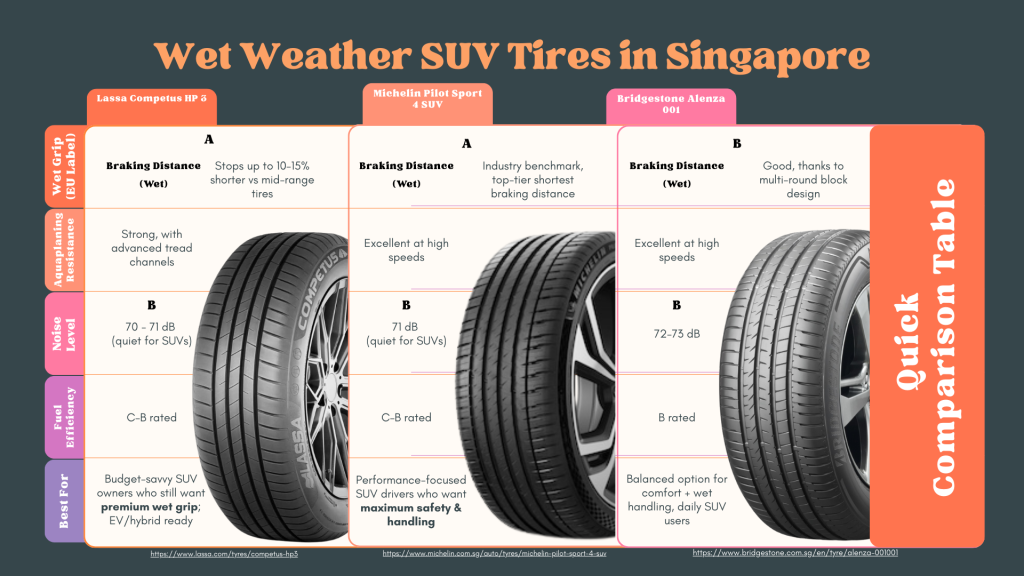
SUV owners looking for safety during Singapore’s monsoon season will find the MICHELIN Pilot Sport 4 SUV leads the pack. This tire rules wet braking and handles amazingly well in rainy conditions, giving exceptional grip and stability even in heavy downpours.
The MICHELIN Primacy 4 SUV delivers balanced performance, while the MICHELIN CrossClimate 2 SUV offers versatility across both dry and wet roads.
For drivers seeking value without compromising safety, the Lassa Competus HP3 is a strong contender. Engineered with Grade A wet grip performance under the EU label, it uses advanced tread compounds to cut braking distance in wet conditions. It’s also EV- and hybrid-ready, designed to handle higher torque while keeping road noise low. If you’re budget-savvy but want premium safety, Competus HP3 is a smart pick.
The Bridgestone Alenza 001 with its multi-round block structure ensures excellent wet handling, while the Yokohama Geolandar CV G058 fights hydroplaning with its optimized groove design.
Comparison Table: Best Wet Weather SUV Tires in Singapore
Not sure if your tires are still safe? Book a free tire check with us today. WhatsApp +65 6925 5296.
Your tires face different challenges in city driving compared to highway cruising. City roads mean more stops and starts, plus those pesky potholes. That’s why city tires come with stronger sidewalls to handle curb damage better.
Highway driving creates more heat because of constant high speeds. Tires made for highways have special tread patterns that stay stable at higher speeds and get rid of heat better.
Singapore’s mixed driving conditions need tires with A or B wet grip ratings for city use. Look for tires with special tread compounds that stay cool and flexible in our tropical heat.
Summer tires are your best bet if safety in wet conditions tops your list. They grip better in rain and resist hydroplaning more effectively. These tires work best in Singapore’s heat, especially above 7°C.
All-season tires make more sense if you want convenience and longer life. They last well throughout the year and don’t need replacement as often as summer tires. They’re also economical solutions if you drive to Malaysia now and then.
Your choice really comes down to what matters more – maximum wet performance or longer tread life and value.
Picking the right wet weather tires for Singapore roads means thinking about our unique tropical climate and driving conditions. The usual rules about tire selection don’t really work for our warm, rainy environment.
Summer tires beat all-season options hands down for wet weather safety in Singapore. They stop shorter, corner better, and resist aquaplaning more effectively during our frequent downpours. The special rubber compounds stay flexible in our hot climate and give you better grip when you most need it.
Notwithstanding that, all-season tires might work better for drivers who want convenience and longevity. Their tough construction usually means longer-lasting treads, which could make up for summer tires’ better performance with improved value over time.
Your driving style will end up determining your choice. SUV owners might like the MICHELIN Pilot Sport 4 SUV to get maximum wet weather protection. City drivers need tires that handle heat well and have strong sidewalls. Anyone who drives highways needs tires that stay stable at high speeds.
Whatever tire type you pick, you can’t skip regular maintenance. Singapore’s high humidity and heat make rubber break down faster, so you’ll need frequent checks. Note that even the best wet weather tires need replacing once tread depth hits 3mm to stay safe in heavy rain.
The right choice matches your safety needs with practical stuff like budget and driving patterns. Summer tires give you the best wet weather performance if safety’s your top priority. All-season options work reliably with less upkeep. Either way, good tires are your best defense against Singapore’s rain-soaked roads.
For Singapore drivers navigating frequent tropical downpours, choosing the right wet weather tires can mean the difference between safe stops and dangerous skids.
• Summer tires outperform all-season options in wet conditions, stopping 58 feet shorter from 60 mph and providing superior grip
• Singapore’s consistent 23-33°C temperatures make the 7°C threshold for all-season tires irrelevant to local driving conditions
• All-season tires offer better value with 60,000km lifespan versus summer tires’ 25,000-40,000km, but compromise wet weather safety
• Replace tires at 3mm tread depth rather than legal 1.6mm minimum to maintain effective water displacement during heavy rain
The choice ultimately depends on whether you prioritize maximum wet weather safety (summer tires) or convenience with longer tread life (all-season). Either way, Singapore’s high humidity accelerates tire aging, making regular inspections essential regardless of your selection.
Q1. Are summer tires better than all-season tires for wet roads in Singapore? Summer tires generally outperform all-season tires in wet conditions in Singapore. They offer shorter braking distances, better cornering stability, and superior hydroplaning resistance due to their specialized rubber compounds and tread patterns optimized for warm, wet climates.
Q2. How often should I replace my tires in Singapore’s climate? In Singapore’s tropical climate, tires typically last 3-5 years regardless of type. However, experts recommend replacing tires after 5 years of use due to accelerated rubber degradation from heat and humidity, with mandatory replacement after 10 years from the manufacture date.
Q3. Do all-season tires offer any advantages for Singapore drivers? All-season tires offer convenience and potentially lower lifetime costs due to their longer tread life (around 60,000 kilometers compared to 25,000-40,000 for summer tires). They provide reliable performance year-round without the need for seasonal changes, which is suitable for Singapore’s consistent climate.
Q4. At what tread depth should I replace my tires for optimal wet weather performance? For optimal wet weather performance, it’s recommended to replace tires once they reach 3mm of remaining tread depth. While the legal minimum is 1.6mm, water displacement capability decreases dramatically below 3mm, significantly affecting safety during heavy rainfall.