
Understanding battery flat meaning is crucial for every vehicle owner who wants to avoid that frustrating moment when your car refuses to start. A dead battery can leave you stranded at the most inconvenient times – perhaps before an important meeting or during severe weather conditions. However, batteries rarely fail without warning signs first.
Most drivers overlook these subtle battery warning signs until it’s too late. From dim headlights to strange odors, your vehicle communicates potential problems well before complete failure occurs. Even premium options like a Varta battery preferred by Singapore drivers will eventually show car battery failing symptoms after years of service. Essentially, knowing what to look for can save you from unexpected breakdowns and costly emergency services.
This comprehensive guide reveals seven critical warning signs that indicate your car battery might be on its last legs – signals you simply cannot afford to ignore in 2025 and beyond.
Age stands as the most reliable predictor of a failing car battery, regardless of how well your vehicle seems to be running. Think of your car battery like a ticking clock – even if everything appears normal, the internal components are gradually wearing down.
The magic number is three years. Car batteries typically last between 3 and 5 years. This timeframe isn’t arbitrary – it represents the point where internal deterioration begins to significantly affect performance. Furthermore, pushing a battery beyond the 5-year mark, even under ideal conditions, substantially increases your risk of unexpected failure.
What makes the 3-year milestone so significant? At this point, the battery’s internal components have endured countless charge cycles, temperature fluctuations, and vibrations. Consequently, the battery’s ability to hold a charge gradually diminishes, even when no obvious symptoms appear.
Your driving environment plays a crucial role in battery longevity. In warmer climates, batteries might only last around 3 years , while those in cooler regions can sometimes extend beyond 5 years. This happens because heat accelerates the chemical reactions inside the battery, speeding up internal deterioration.
Different battery types also exhibit varying lifespans:
Rather than waiting for your battery to fail completely, experts recommend proactive testing. Once your battery reaches its third year, have it tested annually. Some mechanics suggest more frequent checks – every six months after the two-year mark [4]. This preventive approach helps identify gradual deterioration before it leaves you stranded.
Surprisingly, batteries can suffer permanent damage even before installation. Car batteries lose approximately 5% of their charge monthly while sitting on a shelf, and dropping below 75% charge causes permanent internal damage. This is why purchasing a fresh battery matters – one that’s been sitting for six months might start your car but won’t provide the longevity you expect.
For optimal battery performance throughout its lifespan, focus on two key factors: maintaining a full charge and protecting it from temperature extremes. Regular driving keeps the battery charged, while parking in garages during extreme weather provides valuable protection.
Remember that age-related battery issues rarely announce themselves dramatically. Instead, they manifest through subtle changes in performance that gradually worsen. Accordingly, once you’ve passed the three-year threshold, consider yourself officially on borrowed time.
Electrical components often serve as the first warning system when your battery begins failing. Unlike mechanical parts that might mask problems for months, your car’s electrical features react immediately to power supply issues.
The headlights in your vehicle require consistent power to maintain steady illumination. When your battery struggles, flickering headlights are typically the first noticeable sign. This happens because the failing battery cannot provide steady voltage, causing your lights to flicker particularly when idling or using multiple electrical features simultaneously.
This symptom is more than just annoying – it’s a genuine safety concern that makes your vehicle less visible to other drivers on the road. Interestingly, headlight flickering becomes most apparent during short trips or when you’re using other electrical components like the air conditioning or radio.
Your car’s power windows and audio system require substantial voltage to operate correctly. Moreover, these features often malfunction before more critical systems because your vehicle’s computer prioritizes essential functions when power is limited.
Power windows might move sluggishly or stop halfway, especially after you’ve replaced your battery. In fact, automatic windows can easily be thrown off when you replace your vehicle’s battery because the window sensors lose their memory settings. Likewise, many car radios have security features that activate when battery power is removed, causing them to stop working altogether after battery replacement.
Nothing signals electrical troubles more clearly than a dashboard that resembles a chaotic light show. Particularly concerning is when multiple warning lights illuminate simultaneously or flicker intermittently. This typically indicates your vehicle’s computers are struggling to communicate with each other due to insufficient power.
Look for symptoms like RPM gages moving randomly, instrument cluster lights flickering, or the speedometer jumping erratically. These issues often worsen when driving on rough roads as loose connections get temporarily disrupted.
The underlying issue behind all these electrical quirks is typically voltage inconsistency. Your battery should maintain a steady 12-14 volts while running. When this voltage fluctuates due to a dying battery, all electrical components begin behaving unpredictably, effectively broadcasting that your battery is approaching its final days.
That telltale sound when you turn your key reveals volumes about your car’s starting system. Indeed, how your engine responds during ignition attempts provides critical insight into your battery’s health status.
When your engine cranks slower than normal, this typically points to insufficient power reaching the starter motor. This sluggish cranking is one of the clearest signs of a weakening battery that no longer holds sufficient charge to turn the engine over properly.
As batteries age, their ability to provide the substantial current needed for starting deteriorates gradually. Your car engine requires over 100 amps to crank properly – a demand that challenges even healthy batteries. When this cranking power diminishes, you’ll notice the engine turns over more slowly with each passing week.
Occasionally, slow cranking might signal other issues besides a flat battery. Loose or corroded battery terminals can create excessive electrical resistance, preventing full power from reaching the starter. Furthermore, aging wiring can develop breaks in the copper strands inside, reducing their current-carrying capacity over time.
Don’t ignore this warning sign – vehicles experiencing slow cranking increasingly often will typically require a battery replacement soon. Once the starter motor noticeably slows, you’re generally operating on borrowed time.
Clicking noises during ignition attempts signal a different aspect of battery failure. The type of click offers specific diagnostic clues about what’s happening under the hood.
A rapid succession of clicks indicates your battery has enough power to operate the starter solenoid but lacks sufficient current to turn the starter motor fully. Under these circumstances, the solenoid rapidly engages and disengages, creating that distinctive machine-gun-like clicking sound.
In contrast, a single loud click suggests different problems. Typically, this indicates the starter solenoid is attempting to engage the starter but cannot complete the connection. Primarily, this single-click symptom points to a faulty starter motor rather than the battery itself.
For drivers experiencing these symptoms, distinguishing between these sounds helps identify whether the issue lies with the battery or the starter system. Given that battery problems cause most starting difficulties, addressing potential battery issues first typically resolves the majority of cases.
Nose knows best when it comes to diagnosing certain car battery problems. A distinctive odor wafting from under your hood serves as one of the most alarming battery warning signs that demands immediate attention.
That nauseating smell resembling rotten eggs isn’t just unpleasant—it’s a serious warning signal. This distinctive odor occurs when your battery produces hydrogen sulfide gas, a byproduct released when the battery’s internal components begin breaking down. Initially, you might notice this smell only when opening the hood, though it can eventually permeate the entire vehicle.
What causes this smell? The sulfuric acid inside your battery normally converts electrical energy into chemical energy. Nevertheless, when the battery deteriorates, this process becomes compromised. Ultimately, the internal lead plates corrode, allowing contaminants to enter the battery’s electrolyte solution [6]. As these reactions occur, hydrogen sulfide gas forms and escapes from the battery case.
Notably, this rotten egg odor typically indicates your battery is in its final stages of life. The smell becomes particularly pronounced in hot climates where under-hood temperatures can exceed 200 degrees, dramatically accelerating battery deterioration.
The foul smell often accompanies actual leakage of battery acid, presenting additional hazards. Car batteries contain a mixture of sulfuric acid and water—a highly corrosive combination that requires careful handling.
This situation creates multiple dangers:
First and foremost, battery acid can cause severe skin burns and eye damage upon contact. Hence, never touch a leaking battery without proper protection.
Additionally, leaking acid corrodes electrical connections, leading to erratic behavior in your vehicle’s electrical systems. This acid can substantially damage other critical components including your engine, alternator, and starter motor.
Battery leaks rarely resolve themselves. Alternatively, they progressively worsen, potentially causing thousands of dollars in repair costs if ignored. Even premium options like Varta battery Singapore drivers rely on aren’t immune to these issues when they begin failing.
Remember that car battery failing symptoms like this sulfur smell indicate problems requiring prompt action. Driving with a leaking battery can become dangerous as the car battery acid contains sulfuric acid that harms both your health and the environment. Replacing the battery promptly remains the safest solution once you detect this unmistakable warning sign.
Visual inspection provides crucial clues about your battery’s health, with physical deformities being among the most serious battery warning signs. A properly functioning battery should maintain its rectangular shape throughout its lifespan—any deviation from this standard appearance demands immediate attention.
Battery swelling indicates serious internal damage. This bulging or distortion occurs when excessive gas builds up inside the battery case, pushing outward on all sides. Typically, you’ll notice the sides appear puffed out or the entire case looks bloated compared to its original shape. This abnormal appearance signals that something has gone critically wrong with your battery’s internal chemistry.
Overcharging ranks as the primary cause of battery swelling. When your alternator’s voltage regulator malfunctions, it can produce excessive voltage, leading to overcharging. This creates heat and hydrogen gas that builds up rapidly, causing the battery case to bulge. Furthermore, this overcharging accelerates internal damage that cannot be reversed once it occurs.
Temperature extremes similarly contribute to battery swelling. In extremely cold conditions, the electrolyte inside can freeze and expand, causing the sides to bulge as water expands approximately 9% by volume when frozen. Conversely, excessive heat increases chemical reactions within the battery, accelerating gas production and subsequently causing swelling.
Beyond external factors, internal short circuits within the battery frequently cause swelling, unquestionably accompanied by that distinctive “rotten egg” smell mentioned previously. Natural wear after 3-5 years of service additionally weakens the battery’s internal structure, making it more susceptible to swelling.
The dangers of a swollen battery cannot be overstated. First, it poses a genuine explosion risk since the expanding gas can eventually rupture the casing and release toxic chemicals. Second, the battery may leak corrosive sulfuric acid, potentially damaging surrounding engine components, wires, and paint.
When you observe a swollen battery case, replacement becomes the only viable solution. Undeniably, attempting to continue using a physically deformed battery puts both your vehicle and personal safety at risk.
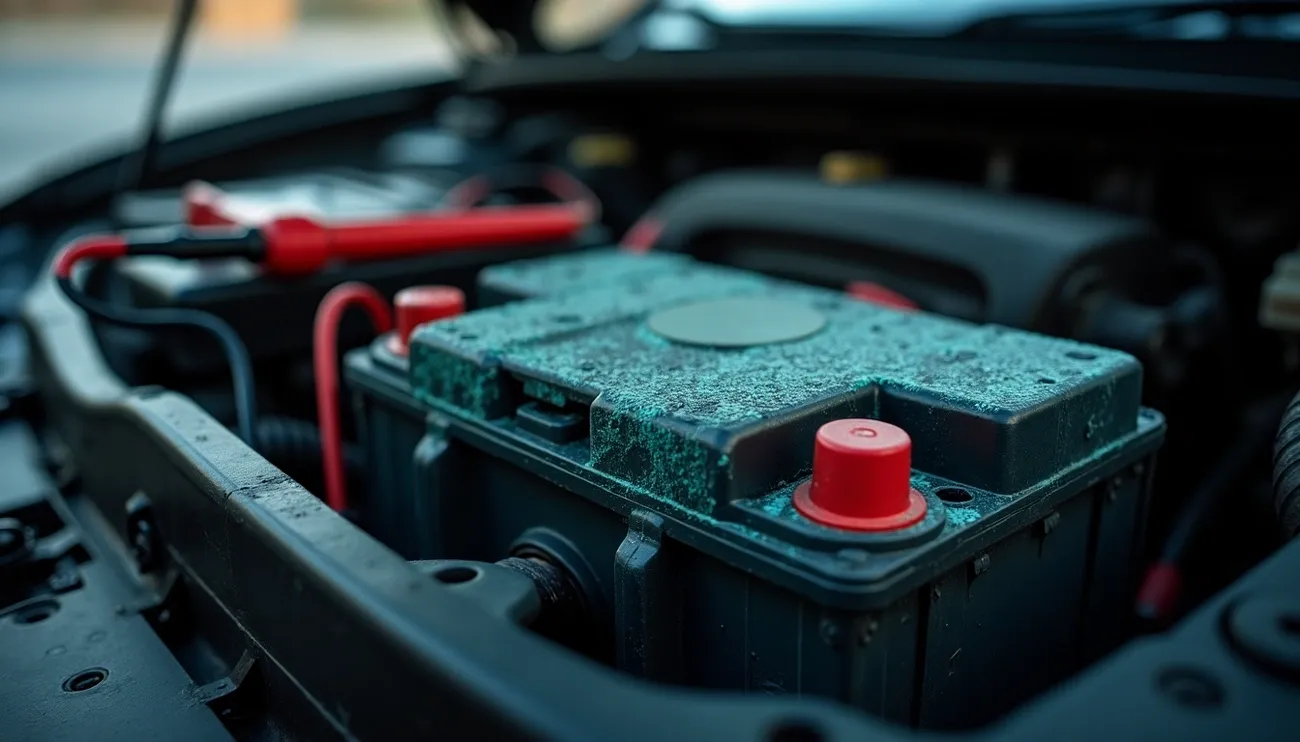
Crusty deposits on your battery terminals tell a story about what’s happening beneath the surface. Terminal corrosion appears as a warning sign that your battery requires attention—a critical signal that might prevent a complete battery flat meaning a car that refuses to start when you need it most.
That distinctive blue-green substance accumulating on your battery connectors isn’t just unsightly—it’s a specific type of corrosion with a particular meaning. This colorful buildup typically forms when hydrogen gas from the battery reacts with copper components in your vehicle’s electrical system.
The bluish material specifically indicates hydrated copper sulfate forming on copper connectors. Primarily, this reaction occurs when hydrogen gas escaping from the battery combines with oxygen and copper wiring or clamps. In turn, this creates an environment where copper oxidizes, forming that characteristic blue-green substance.
Why this matters: This corrosion acts as a poor conductor of electricity, increasing resistance within the circuit. As a result, your vehicle struggles to draw sufficient power from the battery, making it work harder to start and potentially causing damage to other electrical components.
The white, powdery substance appearing around battery terminals or across the battery top represents another form of corrosion—typically lead sulfate or anhydrous copper sulfate. This white film often changes to blue when exposed to moisture, explaining why you might see multiple colors simultaneously.
Terminal corrosion happens because car batteries release small amounts of hydrogen gas during normal operation. Although invisible, this gas reacts with the metal terminals and oxygen in the air, creating sulfuric acid crystals. These crystals then combine with environmental moisture, forming the powdery substance you observe.
Under those circumstances, corrosion gradually builds up between the post and terminal, potentially wearing away the metal connections until they become too brittle to maintain proper contact. Therefore, even the most reliable Varta battery Singapore drivers depend on will eventually show this car battery failing symptom if not properly maintained.
With this in mind, consider checking your battery terminals every six months. Excessive corrosion buildup prevents proper electrical flow, forcing your alternator to work harder charging the battery while simultaneously making the battery struggle more during starting. Notwithstanding its common occurrence, terminal corrosion remains one of the most overlooked battery warning signs that can lead to unexpected failures.
Constantly reaching for jumper cables should trigger immediate concern about your battery’s health. Whereas other warning signs might develop gradually, frequent jumpstarts represent a clear emergency signal that your battery’s condition has reached a critical point.
Multiple jumpstarts indicate serious problems. If your vehicle requires jumping more than once within a short period, this typically means your battery is failing and should be replaced. Many drivers mistakenly believe they can indefinitely rely on jumpstarts rather than addressing the underlying issue, which only compounds the problem.
Certainly, each jumpstart puts additional stress on an already compromised battery. The high current flow during jumping creates added strain on degraded battery cells, ultimately accelerating their deterioration. Jumping a car with a failing battery might get you moving temporarily, but as an actual solution, it merely postpones the inevitable.
Several factors can necessitate frequent jumpstarts:
For the long run, repeated jumpstarting carries significant risks. The process stresses your alternator by forcing it to work at high capacity to recharge a deeply discharged battery. In time, this can damage your alternator—a much more expensive repair than simply replacing the battery.
Finally, consider this: batteries showing the battery flat meaning through frequent jumpstart needs rarely improve without intervention. Even premium options like Varta battery Singapore drivers rely on will eventually display this car battery failing symptom.
As can be seen in mechanical workshops, performing a high-rate discharge test can quickly determine if jumpstart dependency stems from battery issues. In either case, once you’ve jumpstarted your vehicle more than twice in a month, prioritize battery replacement to avoid being stranded at the worst possible moment.
Recognizing these seven warning signs can save you from the frustration of unexpected breakdowns and costly emergency services. Your car battery speaks volumes through these symptoms before completely failing. Therefore, rather than waiting for total battery failure, take proactive steps once you notice any of these telltale signs.
Age remains the most reliable predictor of battery health. Consequently, marking your calendar for replacement around the three-year mark helps avoid most battery-related emergencies. The electrical quirks, slow cranking, unusual odors, physical deformities, terminal corrosion, and repeated jumpstarts all serve as your vehicle’s way of communicating impending battery failure.
Temperature extremes significantly impact battery performance. Accordingly, parking in garages during severe weather provides valuable protection and extends battery life. Additionally, regular driving helps maintain proper charge levels, preventing the deep discharges that permanently damage battery cells.
Even premium batteries eventually show these warning signs after years of service. The difference lies not in whether they fail but how gradually they deteriorate. Despite technological advancements, all car batteries have finite lifespans governed by chemistry and physics.
Remember that addressing battery issues promptly costs significantly less than dealing with the cascade of problems a dead battery creates. A simple battery replacement prevents potential damage to your alternator, starter, and electrical system. Though often overlooked, battery maintenance ranks among the most cost-effective preventive measures for keeping your vehicle reliable. Armed with this knowledge about battery warning signs, you can now confidently avoid that dreaded moment when your car refuses to start.
When your vehicle speaks, we listen. Let’s keep Singapore’s roads safe together. Call 6925 5296 for instant advice or schedule a voltage check today. Navigate with confidence, knowing your car’s heart beats strong through every journey.
[1] – https://www.interstatebatteries.com/blog/how-long-do-car-batteries-usually-last
[2] – https://www.aaa.com/autorepair/articles/how-long-do-car-batteries-last
[3] – https://www.firestonecompleteautocare.com/blog/batteries/when-to-replace-car-battery/
[4] – https://www.autozone.com/diy/battery/how-long-should-a-car-battery-last
[5] – https://autorepairsandrecovery.co.uk/how-long-does-a-car-battery-last/
[6] – https://www.tycorun.com/blogs/news/how-to-spot-battery-leaking-acid-helpful-guide-to-dispose-a-leaking-battery?srsltid=AfmBOor6z4MNRZNzVuApHdD3JjSspzZxdw9XryD2Q5h9Q8j-A9LrfvCN
[7] – https://www.tireoutlet.com/blog/2980/8-signs-your-car-battery-is-dead-or-dying/
[8] – https://www.allstarbatteries.com.au/blog/what-to-do-when-your-car-battery-is-leaking
[9] – https://www.cuttergmc.com/the-traits-of-a-bad-car-battery-that-you-cant-ignore/
[10] – https://dubsgarage.com/blog/what-are-the-signs-of-a-car-battery-leak
[11] – https://swifttyrespecialist.sg/should-i-replace-my-car-battery-after-a-jump/
[12] – https://vocal.media/01/do-jump-starts-damage-your-car-battery
[13] – https://mechanics.stackexchange.com/questions/97653/can-you-rely-on-constant-jump-starts
[14] – https://www.quora.com/What-could-be-the-cause-of-a-car-needing-multiple-jumpstarts-Could-it-be-an-issue-with-the-battery-alternator-or-both